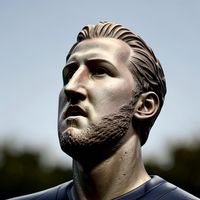
A gleaming metallic representation of English football team captain Harry Kane has joined the ranks of sports statues that have drawn flak for not accurately reflecting the true likeness of their subjects. The statue of Kane was recently unveiled in the London district of Waltham Forest, his birthplace, on a Monday. To commemorate the event, the Tottenham Hotspur striker shared a post on social media, expressing his pride and aspirations for the statue to serve as an inspiration. "An incredibly proud moment for me to return to the place where my football journey began and to unveil this statue. I hope it will motivate the next generation to strive for excellence and have faith in their abilities," he captioned the photo, which humorously highlighted the stark contrast between the real Kane and his bronze counterpart, prompting many to question his genuine approval of the artwork. "Sitting next to it, beaming with pride, seemingly oblivious to its ghastly appearance," quipped one social media user. While some offered their congratulations to Kane, the general consensus was one of bewilderment. "Who does the statue represent?" inquired another commenter. Art critic Estelle Lovatt chimed in with her perspective. "Historically, a public statue was intended to commemorate, flaunt, and loudly celebrate the achievements and accomplishments of an individual. However, if it doesn't resemble the person at all, it becomes challenging to connect with," she told a UK news outlet. "I just can't imagine the Roman emperors tolerating such a standard," Lovatt added. Interestingly, Kane's statue is not the only recent sports-related monument that has fallen short of meeting the standards set by ancient sculptures. In October, the NBA's Miami Heat unveiled a statue of their legendary player and Hall of Fame inductee, Dwyane Wade, which quickly went viral and attracted some unflattering comparisons. Similarly, in 2017, a bust of football icon Cristiano Ronaldo was revealed at an airport in Madeira, his hometown, following the airport's renaming in his honor. The statue quickly became one of the most notorious representations of a sports figure, sparking a social media frenzy over its perceived resemblance—or lack thereof—to Ronaldo.
As the unveiling of Harry Kane's statue in Waltham Forest has sparked a debate on the quality and relevance of public art, it's worth examining the broader implications of such monuments. The statue, meant to honor Kane's contributions to football and inspire future generations, has instead become a subject of ridicule and confusion. This raises questions about the role of public art in society and the responsibility of artists and commissioners to create pieces that are both aesthetically pleasing and representative of their subjects.
The statue's unveiling was a significant event for the community, as it was intended to celebrate one of their own who has achieved international acclaim. However, the public's reaction has been less than favorable, with many expressing disappointment and even amusement at the statue's deviation from Kane's actual appearance. This has led to a discussion about the importance of accuracy in public art and whether a statue that does not resemble its subject can still serve its intended purpose.
Art critic Estelle Lovatt's comments highlight the historical significance of public statues, which were traditionally used to honor and commemorate the achievements of notable figures. She points out that if a statue fails to resemble the person it is meant to represent, it loses its ability to connect with the public and fulfill its intended function. This sentiment is echoed by the public's reaction to Kane's statue, which has been met with confusion and disbelief.
The case of Kane's statue is not an isolated incident. The unveiling of Dwyane Wade's statue by the Miami Heat and the bust of Cristiano Ronaldo in Madeira are two recent examples of public art that have also been criticized for their lack of resemblance to their subjects. These instances suggest a pattern in which modern public art, particularly statues of sports figures, may not be living up to the standards set by ancient sculptures.
This trend raises several questions. Are artists and commissioners placing more emphasis on the concept or design of a statue rather than its likeness to the subject? Is there a lack of communication or understanding between the artist and the subject, leading to a disconnect in the final product? And perhaps most importantly, what can be done to ensure that public art accurately represents its subjects and serves its intended purpose?
One possible solution is to involve the subjects of the statues more closely in the creation process. By consulting with them and taking their input into account, artists can create a more accurate representation that is more likely to be accepted by the public. Additionally, commissioners could consider seeking out artists with a proven track record of creating lifelike sculptures, ensuring that the final product is both visually appealing and true to the subject.
Another approach could be to incorporate more diverse perspectives in the selection and creation of public art. By involving community members, art critics, and historians in the decision-making process, a more comprehensive understanding of the subject and their significance can be achieved. This could lead to the creation of statues that are not only accurate but also resonate with the community they represent.
Ultimately, the controversy surrounding Harry Kane's statue serves as a reminder of the importance of public art in honoring and celebrating the achievements of notable figures. It also highlights the need for careful consideration and collaboration in the creation of such monuments to ensure they are both aesthetically pleasing and true to their subjects. As public art continues to play a significant role in our society, it is crucial that we learn from these examples and strive for excellence in the representation of our heroes.
By Samuel Cooper/Dec 6, 2024

By Sophia Lewis/Dec 6, 2024

By Benjamin Evans/Dec 6, 2024

By Benjamin Evans/Dec 6, 2024

By Joshua Howard/Dec 6, 2024

By Benjamin Evans/Nov 20, 2024

By Natalie Campbell/Nov 20, 2024

By Sophia Lewis/Nov 20, 2024

By Daniel Scott/Nov 20, 2024

By Sarah Davis/Nov 20, 2024

By Lily Simpson/Nov 20, 2024
By David Anderson/Nov 20, 2024

By Sarah Davis/Nov 20, 2024

By Laura Wilson/Nov 20, 2024

By Natalie Campbell/Nov 20, 2024
By Emily Johnson/Oct 15, 2024

By Victoria Gonzalez/Oct 15, 2024
By Benjamin Evans/Oct 15, 2024

By Lily Simpson/Oct 15, 2024

By James Moore/Oct 15, 2024